In this post (5 sections)
After v0.4’s million-game experiment, the game was clearly better. It was also clearly not done. So we went back to the simulator with a smaller, faster batch — 2,000 games, a hundred for each of the ten bot strategies in both modes — and asked what was still broken.
What the bots were still running into
Heat still only went one way. Between 56% and 87% of games still reached heat 90, the zone where federal raids hit and fights spike. The heat-managing strategy — the one that buys every item that lowers heat — was the worst, at 87%. The arithmetic explained it: a quiet day removed 5 heat, while a single fentanyl deal added 10. Two deals a day and you could never get ahead.
Every scratch was permanent. Fights were still the only thing that killed anyone. The odds of a fight had come down, but there was no way to heal between them, so damage simply piled up until one more fight finished you off.
The rich got stuck. The strategy that uses every system in the game peaked around $155 million. At 1% a day, bank interest couldn’t break through, and a mansion took two months to earn back its price.
What we changed
Heat cools faster. Heat now drops by 7 a day instead of 5. Stop trading for three days and you go from 90 to 69 — out of the danger zone. Hard drugs generate a little less heat per deal, the extra heat you draw from moving huge volumes ramps up more gently, and random fights are about 25% rarer. If you keep a clean profile, Detroit’s fight chance roughly halves.
Wounds heal. You now regain 3 HP every day, whether you travel or stay put. A 10-point fight is fully healed in four days, and from 50 HP you’re back to full in about two and a half weeks. You still can’t heal from zero — dying is still dying — but one bad fight no longer quietly dooms the rest of your run.
Street cops hit softer. Local police do 6 damage instead of 8, and state troopers 14 instead of 18.
Money compounds. The bank pays 1.5% a day instead of 1%, and warehouses, mansions and cook labs earn 50–67% more. Here’s what $100,000 does after the 20% deposit fee:
| After | At 1%/day | At 1.5%/day |
|---|---|---|
| 30 days | $107K | $121K |
| 100 days | $216K | $345K |
| 365 days | $2.9M | $17.1M |
What the numbers said afterwards
| v0.4 | v0.5 | |
|---|---|---|
| Best median net worth (Classic) | $558K | $1.4M |
| Careful strategy reaching $1M | 65% | 83% |
| Careful strategy’s death rate (Classic) | 65% | 55% |
| Endless runs surviving to day 60 | 0.7% | 11% |
| Endless runs reaching $100M | 0% | 2% |
That last row is the one we were happiest about: for the first time, a handful of simulated players reached $100 million. Nobody had reached a billion yet. That would take a few more releases.
The buttons that lied
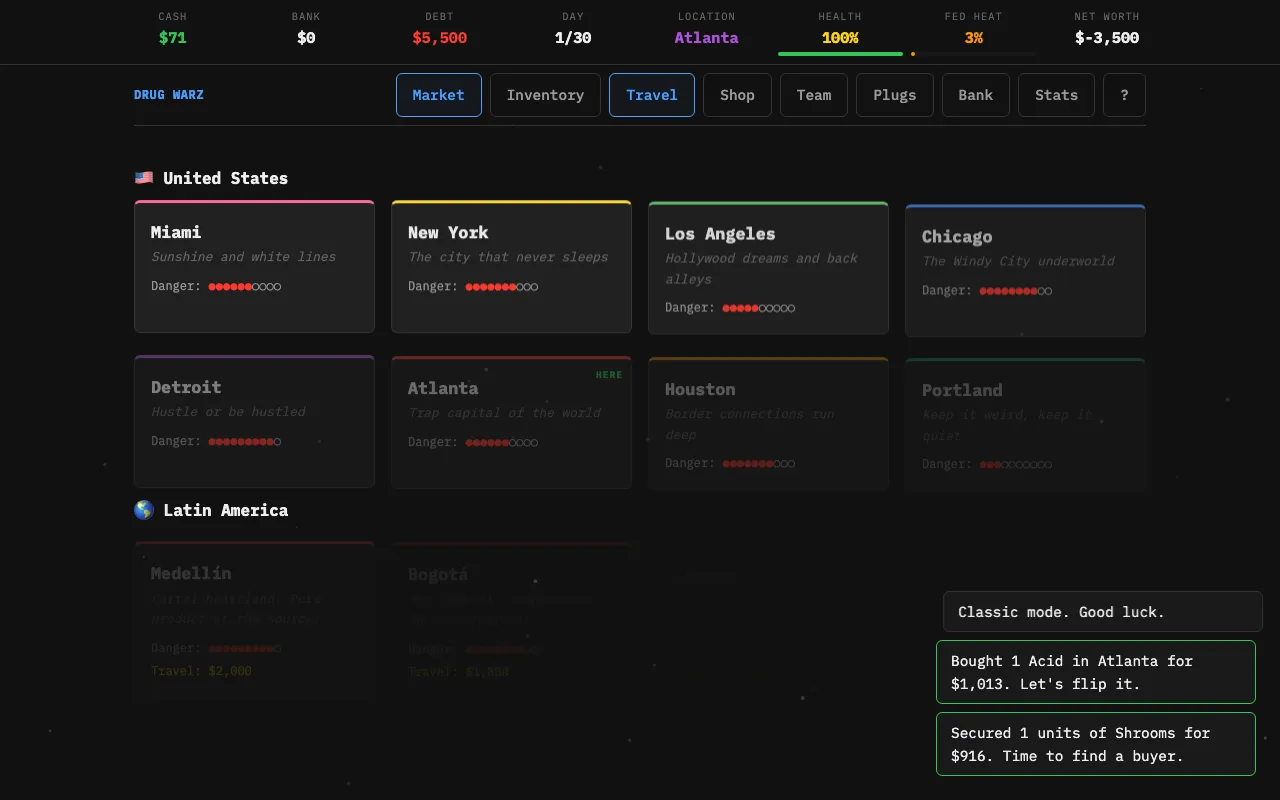
The market used to offer 25%, 50% and MAX buttons. Twenty-five percent of what, exactly? Your cash? Your free space? What you could afford? Players kept tapping the wrong one and buying far more or far less than they meant to.
Now there are just Half and MAX, and they mean what they say:
- When buying, Half is half of what you can afford (counting any territory discount).
- When selling, Half is half of what you’re holding.
The trade preview also shows its working now — how a territory discount or your product’s purity changes the price — so you can see the number before you commit.
What we learned
Small simulations are enough once the big one has shown you where to look. Two thousand games run in seconds, which makes it cheap to try an idea, check it, and throw it away if it doesn’t work. The other lesson: if players keep pressing the wrong button, it’s the button’s fault.
Play Drug Warz — and lay low for a few days when the heat gets high. It works now.